Choosing a Tech Path on a Low-End Laptop: A Software Engineer's Survival Guide
Table of Contents ▼
- ■ The Reality of Tech Bootcamps and Hardware Limitations
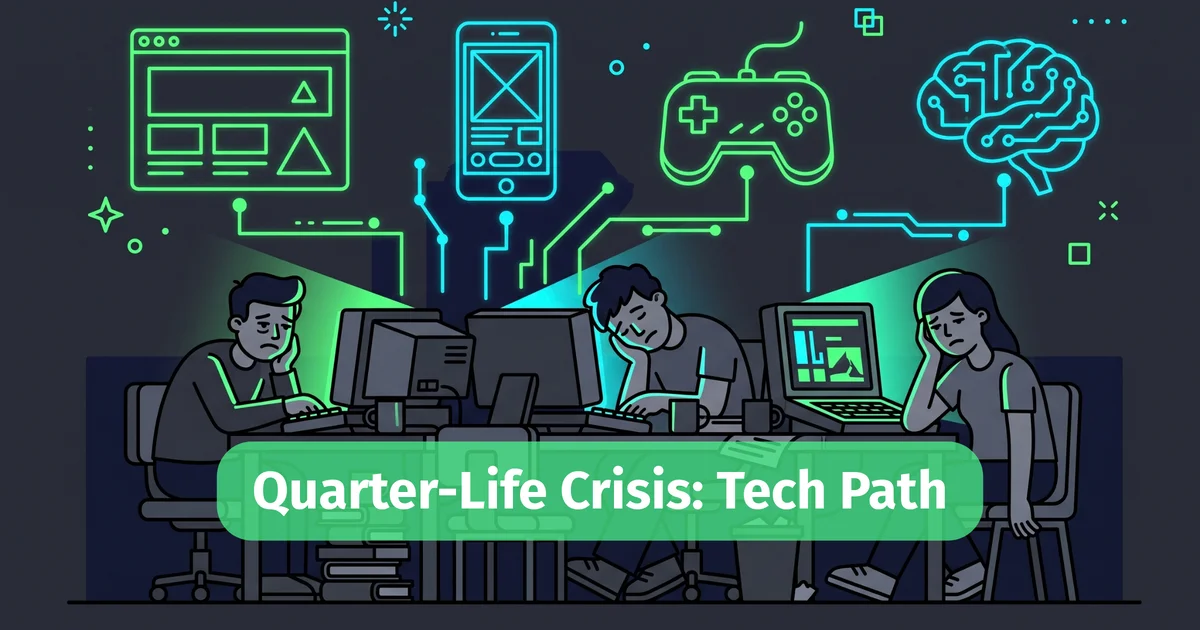
- ■ Software Engineering Roadmap: Web, Mobile, Game, or AI?
- └ 1. Web Development: The Best Coding Path for Low-End Laptops
- └ 2. Mobile App Development: Native Android vs. Cross-Platform
- └ 3. Game Development: The Physics and Hardware Trap
- └ 4. Machine Learning & AI: The Math-Heavy Route
- ■ The Socio-Economic Burden and Post-Graduation Reality
- ■ Surviving the Tech Journey
If you are a university student facing a quarter-life crisis and wondering how to start a software engineering career with a low-end laptop, you are not alone.
In 2022, as my friends and I entered our 7th semester, an existential crisis erupted inside the Engineering Faculty’s Student Council (BEM) room. We had spent a massive amount of money on tuition, our student status was nearing its expiration date, yet our practical tech industry skills were practically zero.
At that time, I was still a generalist. Our discussion centered around one crucial question that every beginner faces: “Which software engineering field should we focus on to secure a job after graduation?”
The Reality of Tech Bootcamps and Hardware Limitations
Before dissecting the tech landscape, we planned an escape route through the Kampus Merdeka program (an Indonesian national tech bootcamp initiative). Our expectations were sky-high: gaining real industry skills and receiving a monthly stipend to survive.
Reality hit us like a freight train. The government abolished the stipend for our cohort, and our university broke its promise regarding credit conversions. We were forced to juggle regular classes, mandatory community service, thesis proposals, and the bootcamp projects all at once. Overwhelmed, my friend who was skilled in design dropped out. I and one other friend recklessly pushed through.
In the midst of that despair, we analyzed our laptop specifications to determine which programming field we could actually survive in. We laughed bitterly. My laptop—a Dell Latitude E5450 (Core i5 Gen 5, 16GB RAM, 256GB SSD)—was considered god-tier among us. My friends had to go to war using outdated Celeron processors with a mere 4 to 8 GB of RAM.
Software Engineering Roadmap: Web, Mobile, Game, or AI?
With severely limited hardware, I outlined the harsh realities of the four main software development fields for my friends:
1. Web Development: The Best Coding Path for Low-End Laptops
The web ecosystem is insanely vast. With Progressive Web Apps (PWA) and Single Page Applications (SPA), modern websites function exactly like native mobile apps.
- The Foundation: Pure HTML, CSS, and JavaScript (specifically DOM manipulation).
- The Ecosystem: On the frontend, you will utilize Node.js, TypeScript, and massive frameworks like React.js or Next.js.
- Hardware Reality: This is the safest field for Celeron laptops. You only need a lightweight code editor and a browser.
- The Challenge: Because the tech stack is so broad, beginners without a clear learning roadmap will easily get lost.
2. Mobile App Development: Native Android vs. Cross-Platform
Unless you own a MacBook, you should forget iOS development and focus on Android.
- Native (Android Studio/Kotlin): Built exclusively for the OS, resulting in incredibly fast apps. However, coding is difficult and extremely resource-heavy. My friend’s Celeron laptop completely froze and failed to launch Android Studio.
- Cross-Platform (Flutter): Allows you to deploy to multiple platforms using one codebase. It features Hot Reload (instant UI updates without recompiling), which is a lifesaver for mid-to-low spec hardware. My friend was ultimately forced to switch to Flutter to survive his thesis.
3. Game Development: The Physics and Hardware Trap
My friend who loved character design initially chose this path. In reality, game development demands high-level mathematical logic, simulated physics, and matrix coordinate calculations.
- Hardware Tragedy: He forced his laptop to run pirated Unity. The result was entirely predictable: his laptop constantly crashed and threw blue screens of death (BSOD). He briefly tried the lighter Godot engine but eventually gave up and pivoted to web design.
4. Machine Learning & AI: The Math-Heavy Route
If you hate Mathematics and struggle with English, do not touch this field. AI requires you to analyze massive datasets and conduct model training. Everything relies purely on calculus, linear algebra, and statistics, with mandatory English scientific literature.
The Socio-Economic Burden and Post-Graduation Reality
Laptops freezing during application builds and staring at screens full of red error codes became our daily routine. To prolong the life of our dying machines, we completely migrated to the Linux operating system.
However, the heaviest pressure wasn’t debugging code; it was the socio-economic burden. We were kids from lower-middle-class families navigating college without financial safety nets. Our families imagined that a 2023 bachelor’s degree was an instant ticket to a high-paying corporate job.
The reality? We were all unemployed for the first three months.
During 2.5 years of the pandemic, our networking was locked entirely within our small circle of campus friends. We had zero capital to relocate to tech hubs, no industry connections, and were utterly crushed by the competition. We took whatever jobs we could find, including becoming underpaid contract teachers at elementary schools. Those days were filled with dense depression and frustration.
Surviving the Tech Journey
Three years after that bitter discussion, our paths have completely diverged. My designer friend left coding to focus entirely on visual design. My other friend, overwhelmed by his duties as a contract teacher, slowly abandoned his software engineering dreams.
And me? The administrative demands of being a teacher and IT operator at a small school forced me into passivity. For the past three years, I have only done minor maintenance on my apps in the Play Store. However, those applications are the only digital artifacts I retain as a testament of responsibility to the knowledge I fought so hard to learn.
Aging hardware limitations and blunted skills are certainly obstacles, but my plan is to reopen the documentation and start learning again this November 2026. Hopefully, this time, circumstances will be on my side.